

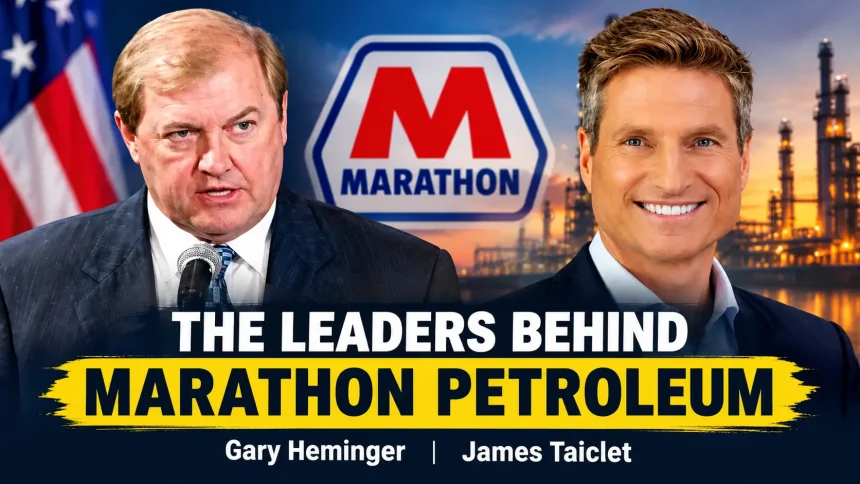
Jim Taiclet and Gary Heminger are two of America’s most closely watched corporate leaders. Taiclet is chairman, president and CEO of Lockheed Martin. Heminger is the retired chairman and CEO of Marathon Petroleum. Taiclet’s lessons center on vision, transformation and partnerships. Heminger’s center on patience, long-term talent development and disciplined execution. This guide covers who they are, what their careers show, and how to apply their leadership habits in your own work.
Who Are Jim Taiclet and Gary Heminger?
Jim Taiclet leads one of the world’s largest defense contractors. Gary Heminger spent more than four decades at one energy company and rose to run it. Their paths are very different, but both led large, capital-intensive, heavily regulated businesses where decisions play out over many years.
| Current/last role | Chairman, President & CEO, Lockheed Martin | Retired Chairman & CEO, Marathon Petroleum |
| Industry | Aerospace and defense | Refining, midstream, retail fuel |
| Path to the top | Air Force Academy, aerospace and telecom executive | Joined Marathon in 1975, rose over 40+ years |
| CEO tenure | Lockheed Martin since June 2020 | Marathon Petroleum, July 2011 to March 2020 |
| Defining theme | Transformation and open partnerships | Long-term development and steady execution |
Jim Taiclet: From Air Force Officer to Defense Industry CEO
According to Lockheed Martin’s official biography, Taiclet joined the company’s board in January 2018, became president and CEO in June 2020, and added the chairman title in March 2021. Before that he was chairman, president and CEO of American Tower, a global communications real estate company.
The Council on Foreign Relations describes him as a distinguished graduate of the U.S. Air Force Academy, with bachelor’s degrees in engineering and international relations. His earlier roles included president of AlliedSignal’s aerospace services business (later part of Honeywell) and vice president of engine services at Pratt & Whitney. He also sits on the board of Mass General Brigham and is a member of The Business Council.
At American Tower, Lockheed’s bio states, the company’s market capitalization grew from roughly $2 billion to more than $100 billion, and the business expanded from mainly U.S. operations to 19 countries. That record is why many observers see him as a rare leader who has transformed two very different industries.
Gary Heminger: The Marathon “Lifer” Who Reached the Top
Heminger joined Marathon in 1975 and earned a bachelor’s degree in accounting from Tiffin University in 1976 while already working for the company in Findlay, Ohio. He moved through marketing, pipelines and business development roles, became president of Marathon Petroleum Company LLC in 2001, and was named president and CEO of Marathon Petroleum Corporation on July 1, 2011. He became chairman in 2016 and retired in March 2020.
Chief Executive magazine profiled him as a “lifer” who took a long, steady road to the top. Since retiring, he has served on corporate boards, including PPG and Fifth Third Bancorp, and has been associated with The Ohio State University’s board of trustees.
Jim Taiclet’s Leadership Skills
Taiclet’s approach is built on a few repeatable habits. Each can be seen in his public career and statements.
1. Build a Vision That Reframes the Industry
Taiclet describes his strategy at Lockheed Martin as “21st Century Security.” In the company’s own words, it brings together traditional defense firms, new entrants, and the technology and telecom sectors, using open, standards-based architecture, to deliver “integrated deterrence” for the U.S. and its allies.
The leadership lesson is that a good vision does more than state a goal. It changes how people see the industry. By treating defense as a digital and networked challenge, not only a hardware business, Taiclet gave employees, partners and investors a clear frame for decisions. If your vision could apply to any competitor, it isn’t doing its job.
How to apply it: Write a one-paragraph statement of how your market will look in ten years and what role your team plays. Test it by asking whether it would change a real decision this quarter.
2. Bring Outside Experience Into a Traditional Industry
Taiclet came to Lockheed from the telecom infrastructure world, not from a long career inside a defense prime. His time as a military officer, an aerospace executive and a telecom CEO gave him a cross-industry view. That perspective shows up in his emphasis on bringing commercial technology and telecom, including 5G networking, into defense work.
The lesson is that breadth is an asset. Leaders who have worked across sectors often spot practices that insiders consider impossible or unnecessary.
How to apply it: Spend time with people in adjacent industries. Ask what they do routinely that your field treats as unusual.
3. Lead Transformation With Numbers and Narrative
The American Tower record gives Taiclet credibility. A move from about $2 billion to more than $100 billion in market value required acquisitions, international expansion and operational discipline over roughly sixteen years. Leaders who talk about transformation without a track record are easy to dismiss. Taiclet can point to results.
A second point is the pairing of story and metrics. A transformation needs a narrative people can repeat and scorecards that show whether it is working. One without the other either inspires without delivering or delivers without inspiring.
How to apply it: For any major initiative, define three measures of success before launch and share the story behind them with the whole team.
4. Think in Partnerships, Not Only Competition
Taiclet’s public framing stresses collaboration among established defense firms, technology companies and telecom providers. Partnerships can speed up development and spread risk, but they also require clear standards and trust.
His corporate record also shows that big strategic moves are not guaranteed. Lockheed’s proposed acquisition of Aerojet Rocketdyne was announced in late 2020 and later called off after regulatory challenge in early 2022. Even skilled leaders face outcomes they cannot control, and that is a useful reminder to prepare alternatives for any strategy that depends on outside approval.
How to apply it: Map which of your goals depend on partners or regulators, and write a plan B for each.
5. Stay Anchored in Mission
Taiclet’s military background shapes how he talks about Lockheed’s work: as a mission with national security consequences, not just a business line. A clear mission helps people stay motivated through long programs and cyclical budgets.
How to apply it: Remind your team regularly who benefits from their work and what happens if it fails.
Gary Heminger’s Leadership Skills
Heminger’s career offers a different model: depth, continuity and development of people.
1. Treat Leadership Development as a Long-Term Investment
In a 2017 interview with LEADERS magazine, Heminger said that in a capital-intensive business, leaders must develop people with a long horizon in mind, and that succession planning and development are a key part of the CEO’s job. Marathon also uses a defined leadership profile and competencies so expectations are clear.
Heminger’s own career is the proof of concept. He rose through many roles over more than four decades. A company that promotes from within and invests in training builds institutional knowledge that outsiders take years to acquire.
How to apply it: Identify two or three people who could take on your role in the future. Give each a stretch assignment this year and schedule regular feedback.
2. Know the Numbers and Explain Them Clearly
Heminger’s background is in accounting and business development, and coverage of his career highlights financial skill as a reason he was valued. He also said leaders must be able to explain quarter-to-quarter results with strength and clarity, even while managing for the long term.
This is a balancing act many executives struggle with: short-term accountability to investors versus long-term investment. Heminger’s answer was to explain the short term honestly and keep the long-term plan visible.
How to apply it: In every report to stakeholders, include both what happened this period and how it fits the multi-year plan.
3. Lead Through Structural Change
Heminger became CEO when Marathon Petroleum was spun off from Marathon Oil in 2011, giving the downstream business its own identity. Under his leadership the company later built out its midstream business through MPLX and completed the acquisition of Andeavor in 2018. Each step reshaped the company’s scale and structure.
The lesson is that continuity of leadership can make complex change easier. People who know the business deeply can make big moves with fewer surprises.
How to apply it: Before a restructuring, document how the business really works, including informal processes, so changes don’t break what is working.
4. Master the Basics of Operations
Refining and fuel distribution are operationally demanding, and safety, reliability and cost control matter every day. Heminger’s long experience across marketing, pipelines and business development gave him a close view of how decisions at headquarters affect operations.
How to apply it: Make time to see frontline work firsthand. Reports show results, but only direct observation shows why they happen.
5. Plan the Exit
Heminger retired in March 2020 and handed the CEO role to a successor after years of succession planning. Leaving on a planned timeline, with a prepared successor, protects the organization and reflects confidence in the team.
How to apply it: Document your key decisions and relationships now, as if you were leaving in a year.
How Their Leadership Styles Compare
Both leaders think long term and care about developing people, but their emphasis differs.
- Starting point: Taiclet begins with an external vision and works backward to capabilities. Heminger begins with the strength of the organization and builds outward.
- Career shape: Taiclet moved across industries. Heminger deepened expertise inside one company.
- Growth model: Taiclet’s record highlights global expansion and partnership. Heminger’s emphasizes structure, scale and operational execution.
- Communication: Taiclet frames strategy as mission. Heminger frames it as disciplined, understandable performance.
Neither approach is better. A fast-changing market may call for Taiclet’s reframing, while a stable, asset-heavy business may reward Heminger’s patience. Strong leaders know when to use each.
Seven Practical Steps to Build These Skills
- Write a vision that changes decisions. Make it specific enough that a competitor couldn’t copy it word for word.
- Set three measurable goals for your biggest initiative and share them openly.
- Learn an adjacent field. Read, interview or shadow someone outside your industry each quarter.
- Build a partner map. List who you depend on and what could go wrong.
- Develop successors. Give emerging leaders real responsibility and feedback.
- Report short-term results alongside long-term plans. Show how today’s numbers connect to the bigger picture.
- Spend time at the front line. Visit the place where the work actually happens.
Common Mistakes When Studying Executive Leaders
- Copying style without context. What works in defense or energy may need adjusting for a startup or a nonprofit.
- Relying on unreliable sources. Many low-quality websites repeat inaccurate biographical details. For example, some pages confuse the companies or titles of these executives. Use company bios, regulatory filings and reputable business media.
- Ignoring setbacks. Both careers include challenges, such as blocked deals or industry downturns. Learning from them matters as much as learning from successes.
Conclusion
Jim Taiclet shows how a leader can reframe an industry, build partnerships and carry a mission through a major transformation. Gary Heminger shows how patience, financial fluency and careful succession planning can sustain a large organization for decades. Combine the two: set a bold vision, then build the people, numbers and operating discipline to deliver it. Pick one habit from each leader, apply it this quarter, and measure the result.
Related reading ideas for internal linking: succession planning basics, how to write a vision statement, leadership lessons from other Fortune 500 CEOs.